

Last Updated: November 4, 2026
Quick Summary
To pick safe chew toys for small dogs, match the toy to your dog's chewing style and jaw strength, then choose non-toxic materials like natural rubber or food-grade silicone. The toy should be longer than your dog's muzzle so he can carry it but not swallow it, and you should check it weekly for cracks or loose parts.
- Chewing style falls into three groups: gentle, moderate and power chewers.
- Avoid toys containing BPA, PVC, phthalates or formaldehyde.
- Press a fingernail into the toy: a slight dent means it is flexible enough.
- The toy should be longer than your dog's muzzle and never fit fully in his mouth.
- Replace a chew toy as soon as it shows cracks, missing pieces or loose parts.
Table of Contents
- Start With Your Dog's Chewing Style and Jaw Strength
- Choose Non-Toxic Materials That Hold Up to Small Jaws
- Get the Size Right: Big Enough to Hold, Small Enough to Carry
- Spot the Choking Hazards Before They Reach Your Dog
- Durable Chew Toys for Small Dogs: What Toughness Really Means
- Best Chew Toys for Small Dog Teething: Soothing Sore Gums Safely
- Signs of Worn Out Dog Toys and When to Replace Them
- Add to Cart: Choosing Your First Safe Chew Toy
- Frequently Asked Questions
Start With Your Dog's Chewing Style and Jaw Strength
Watch your dog for a few days before you buy anything.
Chewing style falls into three broad groups:
- Gentle chewers: mouth the toy softly, rarely damage it
- Moderate chewers: work away steadily, cause wear over weeks
- Power chewers: bite hard and fast, destroy soft toys in minutes
Jaw strength matters just as much. A common mistake is buying for breed size alone. A small dog with a powerful bite will wreck a toy built for a gentle giant.
Puppies add another layer. If you're unsure how old your dog is or how his feeding ties into growth, our guide on how much to feed my puppy helps you track development alongside chew habits.
Match the toy to how your dog actually chews by sorting him into one of three chewing styles.
| Chewing style | How the dog chews | What to expect |
|---|---|---|
| Gentle chewers | Mouth the toy softly | Rarely damage it |
| Moderate chewers | Work away steadily | Cause wear over weeks |
| Power chewers | Bite hard and fast | Destroy soft toys in minutes |
Choose Non-Toxic Materials That Hold Up to Small Jaws
Non-toxic chew toys are made from materials that won't leach harmful chemicals when a dog chews, mouths or swallows small pieces. For small dogs, the material matters more than the shape, because a small mouth works a toy differently: more grinding, more saliva, more time spent on the same square centimetre of surface.
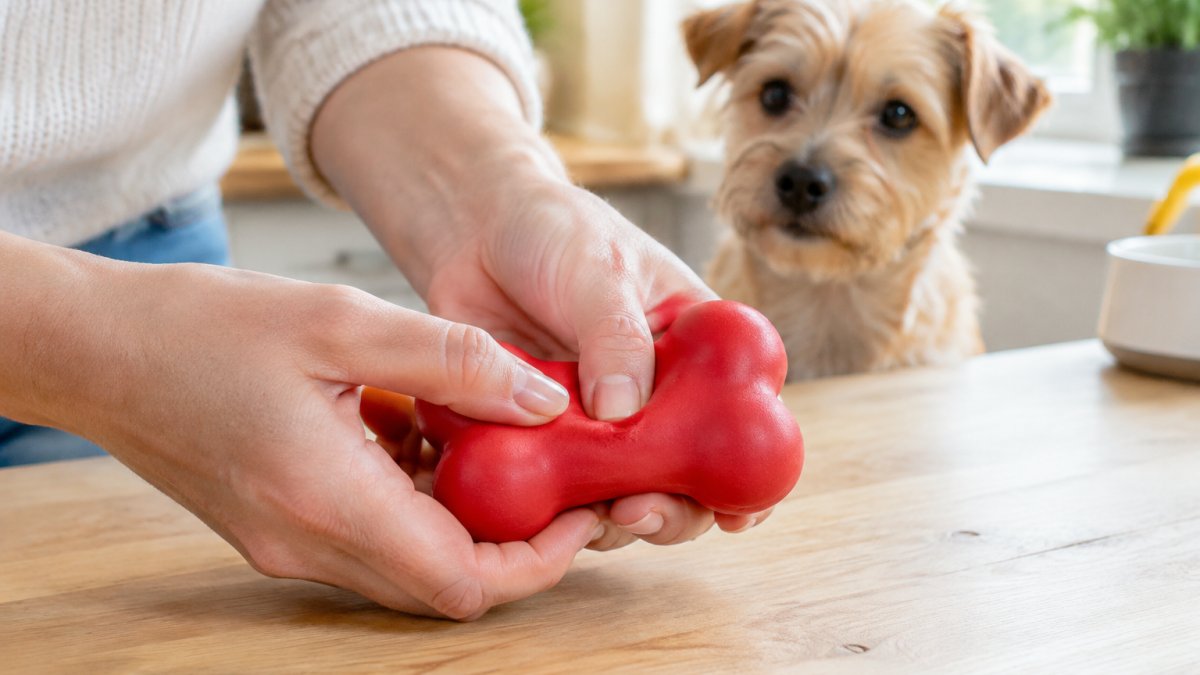
Look for these safe options:
- Natural rubber: flexible, tough, bounces back after chewing
- Food-grade silicone: soft, easy to clean, good for teething
- High-quality nylon: firm, long-lasting, best for determined chewers
Avoid toys containing BPA, PVC, phthalates or formaldehyde. The Humane World guidance on safe dog toys recommends checking material composition before purchase, not after.
Read the label like a safety document
Most guides stop at "non-toxic". The more useful skill is knowing which claims on a packet are meaningful and which are marketing. Look for:
-
"BPA-free" and "phthalate-free": These are meaningful, but only if the manufacturer names the material (e.g. "food-grade silicone" or "natural rubber") alongside it. A vague "non-toxic" stamp with no material named tells you nothing.
-
"Food-grade": A real descriptor for silicone and some plastics; it means the material is suitable for contact with food, which is a reasonable proxy for mouth contact.
-
"FDA-compliant" or "FDA-approved material": Common on imported toys, this refers to the material's food-contact status, not to the toy being tested as a whole. Treat it as one signal, not a guarantee.
-
Recycling code on the base: A number inside a triangle (e.g. 5 for polypropylene) tells you the plastic family. It is not a safety rating, but it lets you check the material against known concerns.
Watch out: a toy can be labelled "BPA-free" and still contain PVC or phthalates, so read the full material line rather than stopping at the first safe-sounding claim.
The fingernail test, and its limits
Press a fingernail into the toy. If it leaves a slight dent, the material is flexible enough to be safer on teeth. If it's rock hard, it can fracture teeth, especially the small, closely spaced incisors of toy breeds.
The fingernail test tells you about firmness, not chemistry. Use it to rule out brittle toys, then use the label to rule out risky materials.
At Easy Pets, we stock toys from trusted Australian manufacturers and distributors.
Get the Size Right: Big Enough to Hold, Small Enough to Carry
The right size chew toy is one your small dog can carry comfortably but cannot fit entirely inside his mouth at once.
Size rules for small dogs:
- The toy should be longer than your dog's muzzle
- He should be able to grip it with both paws
- It must not disappear fully into his mouth
The American Kennel Club's puppy toy guidance stresses size-appropriate toys for smaller breeds, since oversized toys cause jaw strain and undersized ones become choking hazards.
A quick check: hold the toy against your dog's head. If it's smaller than his muzzle, it's too small.
Spot the Choking Hazards Before They Reach Your Dog
A choking hazard is any part of a toy that can detach and block your dog's airway or become lodged in the gut.
Check every new toy for these red flags:
- Loose squeakers that can be pulled out
- Glued-on eyes, bells or decorations
- Thin rope that can fray into strands
Squeakers deserve special attention. Many small dogs work relentlessly to extract them. If a toy has an exposed squeaker, either remove it or choose a toy with the squeaker sealed inside.
Swallowed parts can cause gastrointestinal obstruction, which often means surgery. That's a serious outcome from a cheap toy.
For dogs that love to dig and pull, an interactive toy with enclosed squeakers keeps the fun without loose pieces. The Zippy Paws Burrow Churros toy hides three squeaker toys inside a plush burrow, so the small parts stay contained during play.
Durable Chew Toys for Small Dogs: What Toughness Really Means
Durable chew toys for small dogs resist wear and tear without being so hard they damage teeth.
No toy is indestructible. The Complete Guide to Dog Chew Toys makes this clear: match the chew to your dog's style and weight rather than trusting any "indestructible" label.
What real toughness looks like:
- The toy springs back after being compressed
- Edges stay smooth as the dog chews
- No chunks break off under pressure
Brittle toys are the danger. Hard plastic that snaps can leave sharp edges and fractured teeth. A flexible rubber toy absorbs the bite and wears down slowly instead.
Why small-breed jaw mechanics change the choice
Most guides treat "small dog" as one category. It isn't. The two broad skull shapes found in small breeds load a chew toy very differently, and that changes which durable toy is the safer pick.
Brachycephalic (short-snouted) breeds, pugs, French bulldogs, Boston terriers, shih tzus, cavalier King Charles spaniels. These dogs have a short muzzle, a wide jaw and often crowded or rotated teeth. They tend to grip a toy with the back molars and the sides of the mouth rather than the front incisors. That means:
- They favour wider, flatter toys they can hold against the side of the jaw.
- Narrow toys that require front-teeth gripping are awkward and often abandoned.
- Because their teeth are crowded, a hard toy concentrates force on a small number of teeth; softer rubber is usually the better match.
Mesaticephalic and dolichocephalic (medium- and long-snouted) small breeds, Jack Russells, miniature pinschers, dachshunds, Chihuahuas, toy poodles. These dogs have a longer tooth row and a more scissor-like bite. They tend to:
- Grip with the full length of the jaw, which spreads load and lets them work a firmer toy safely.
- Do better with longer, narrower chews that reach the back molars.
- Generate a surprisingly high bite force for their size; a Jack Russell can out-chew many medium breeds on a soft toy.
A common pattern is that owners buy for weight and ignore skull shape. A 7 kg French bulldog and a 7 kg Jack Russell need different durable toys even though the label says the same size range.
Matching toughness to the jaw in front of you
Use this as a starting framework rather than a rule:
- Short-snouted, gentle to moderate chewer: soft-to-medium natural rubber, wide shapes, treat pockets that keep the toy moving rather than pinned against the molars.
- Short-snouted, power chewer: medium rubber with a thick wall; avoid narrow nylon bones that concentrate force on crowded teeth.
- Long-snouted, gentle to moderate chewer: standard rubber chews and rope under supervision.
For small dogs with real jaw strength, the KONG Classic Small is a solid pick. It's the iconic KONG shape in a small size, around 50 grams, built to take everyday chew time.

Watch out: a toy rated "for small dogs" by weight can still be too firm for a brachycephalic jaw or too soft for a determined terrier; the weight range on the packet is a starting point, not a verdict.
Best Chew Toys for Small Dog Teething: Soothing Sore Gums Safely
The best chew toys for small dog teething are soft enough to soothe sore gums but firm enough to survive gentle mouthing.
Teething puppies have specific needs:
- Softer rubber that gives under pressure
- Textured surfaces to massage gums
- Treat-dispensing designs to hold attention
The Guide Dogs puppy wellbeing resources note that puppies explore the world through their mouths, so safe chew options support both comfort and behaviour.
A frozen or chilled rubber toy can ease aching gums during active teething. Always supervise, and check the toy for damage after each session.
KONG's Puppy range suits this stage well. The KONG Puppy Small uses softer puppy rubber for gentle early chew time. For treat-dispensing engagement, the KONG Puppy Binkie Teething toy has a pacifier shape designed to soothe sore teeth and gums, sized for small breeds.


Signs of Worn Out Dog Toys and When to Replace Them
Replace a chew toy as soon as it shows cracks, missing pieces, exposed inner material or loose parts. Waiting for total destruction is how swallowed parts happen.
Watch for these signs of worn out dog toys:
- New cracks or splits in the surface
- Chunks missing from edges
- Exposed squeakers or stuffing
Run a weekly check. Flex the toy in your hands and look for damage you'd miss at a glance.
Toy maintenance extends safe life. Wash rubber and silicone toys in warm soapy water, rinse well and dry fully.
Add to Cart: Choosing Your First Safe Chew Toy
Choosing safe chew toys comes down to four checks: the right material, the right size, the right firmness for your dog's chewing style, and a habit of checking for wear. Get those right and you remove most of the risk.
Start with one durable rubber toy and one softer option for variety. Watch how your dog works each one, then adjust.
That's where Easy Pets makes it simple. We're an Australian family-owned online retailer with over 8,000 products, honest product information and fast dispatch Australia-wide.
Ready to shop? Add the right chew toy to your cart and give your small dog something safe to sink his teeth into.
Frequently Asked Questions
What materials are safest for small dog chew toys?
Natural rubber, food-grade silicone and high-quality nylon are the safest picks for small dogs. These materials flex or wear predictably instead of shattering. Avoid toys containing BPA, PVC or formaldehyde, and skip anything so hard your fingernail cannot leave a slight dent, as rigid materials can fracture teeth.
How do I know if a chew toy is the right size for my small dog?
The toy should be large enough that your dog cannot fit the whole thing in their mouth at once, which prevents choking, but small enough to carry comfortably without struggling. A toy that is too small can be swallowed whole; one that is too large gets abandoned. Check the listed dimensions against your dog's mouth and weight, and size down only for gentle chewers. Replace the toy as soon as it wears down, since a chewed-down toy effectively becomes a smaller, riskier one.
How often should I replace my dog's chew toys?
Replace a chew toy as soon as you see wear and tear: cracks, missing chunks, exposed squeakers or a texture that has gone brittle. No chew toy is indestructible, so check toys after every session and remove any with pieces starting to break off. For power chewers, that may mean weekly checks; for gentle chewers, monthly is often enough. Rotating toys between sessions also reduces wear on each one and keeps your dog interested.
Are nylon chew toys safe for small dogs?
Nylon is generally safe for small dogs when it is the right size and matched to their chewing style. It is harder than rubber, so it suits determined chewers but not puppies in the middle of teething, whose gums need something softer. Supervise nylon chews, inspect them for rough edges or cracked sections, and replace them once they wear down. Avoid any nylon toy small enough to be swallowed whole, and never treat any chew toy as indestructible.
