

Quick Summary
To verify pet food ingredient sources, look past the ingredient list and ask the brand where each main protein comes from, who supplies it, and whether batches can be traced. Then ask for the supporting document behind every answer, such as audit summaries, certificates or test reports, and note what each one actually covers.
- An ingredient list shows what is in the food, not where ingredients came from or how suppliers were checked.
- Circle the top three ingredients and check whether each is named specifically, such as chicken or New Zealand salmon.
- Ask whether ingredients are traced by batch or lot, and whether the brand can match your bag to a supplier.
- Ask for the document behind every claim, then check what that document actually covers.
- Record what you were told, what evidence you saw, and what remains unverified before comparing products.
Table of Contents
- Why an Ingredient List Alone Does Not Show Where Ingredients Came From
- How to Read a Pet Food Label for Ingredient Clues
- Step 1: Identify the Ingredients You Want to Trace
- Step 2: Ask the Brand the Right Questions About Sourcing
- Step 3: Judge Whether the Answers Are Credible
- Step 4: Use a Pet Food Quality Checklist Before You Buy
- Booking Your Next Order With Confidence at Easy Pets
- Frequently Asked Questions
Why an Ingredient List Alone Does Not Show Where Ingredients Came From
The ingredient list on a pet food bag tells you what is in the food.
Pet food choices are driven by several factors at once, and understanding pet food ingredient sources is one of the most important of them. A systematic literature review on pet food choices identified product quality, ingredient composition, price, brand reputation, sustainability and pet health status as recurring factors.
This is why ingredient sourcing needs a separate check. The label answers "what," but sourcing questions answer "from where" and "under what standards." Those answers usually come from the brand, not the bag.
Owners can also be misled by the labelling itself. For a broader practical walkthrough, see how to verify Australian pet food claims.
How to Read a Pet Food Label for Ingredient Clues
The label still matters. It gives you the first set of clues to test later. Read it with a clear goal: find the questions you need to ask.
Ingredient order, named proteins and animal meals
Ingredients are listed by weight before cooking. The first few items usually make up most of the food. Look at whether the top protein is named precisely, such as "chicken" or "New Zealand salmon," or described only in general terms.
Watch for these patterns:
- Named proteins identify a specific animal source, such as "lamb" or "salmon."
- Generic terms like "meat" or "animal protein" give less detail about origin.
- Animal meals are rendered products. They can be a valid protein source, but the label alone does not say which animal parts they came from.
- By-products are not automatically poor quality, but they need a clear supplier and specification to trust.
Try this simple habit: circle the top three ingredients, then note whether each one is named specifically. Any vague term becomes a question for the brand.
Guaranteed analysis and what it does not tell you
The guaranteed analysis lists minimum or maximum percentages of protein, fat, fibre and moisture. It helps you compare nutrient levels between products.
It does not tell you where the protein came from, how digestible it is, or whether the food was made under consistent quality control.
Look for a nutritional adequacy statement too. It shows the food is complete and balanced for a life stage.
Korure Pets NZ King Salmon Tails Dog Treats 50g →
Step 1: Identify the Ingredients You Want to Trace
Before you contact anyone, decide which ingredients matter most to you. Trying to trace every item on a long list wastes time and usually produces vague answers.
Focus on:
- The top three ingredients, since they make up most of the food.
- Any animal meals or by-products, which need the most detail.
- Ingredients linked to allergies or intolerances for your pet.
- Any specific claims on the pack, such as "grass-fed" or "wild-caught."
Write these down in a short list. A focused list gets clearer answers from the brand.
- Protein sources you want named precisely
- Any meals or by-products you want explained
- Claims you want backed up with evidence
Step 2: Ask the Brand the Right Questions About Sourcing
Once you know what to trace, contact the brand. Good questions ask for specific, checkable information and, crucially, for the document that sits behind the answer.
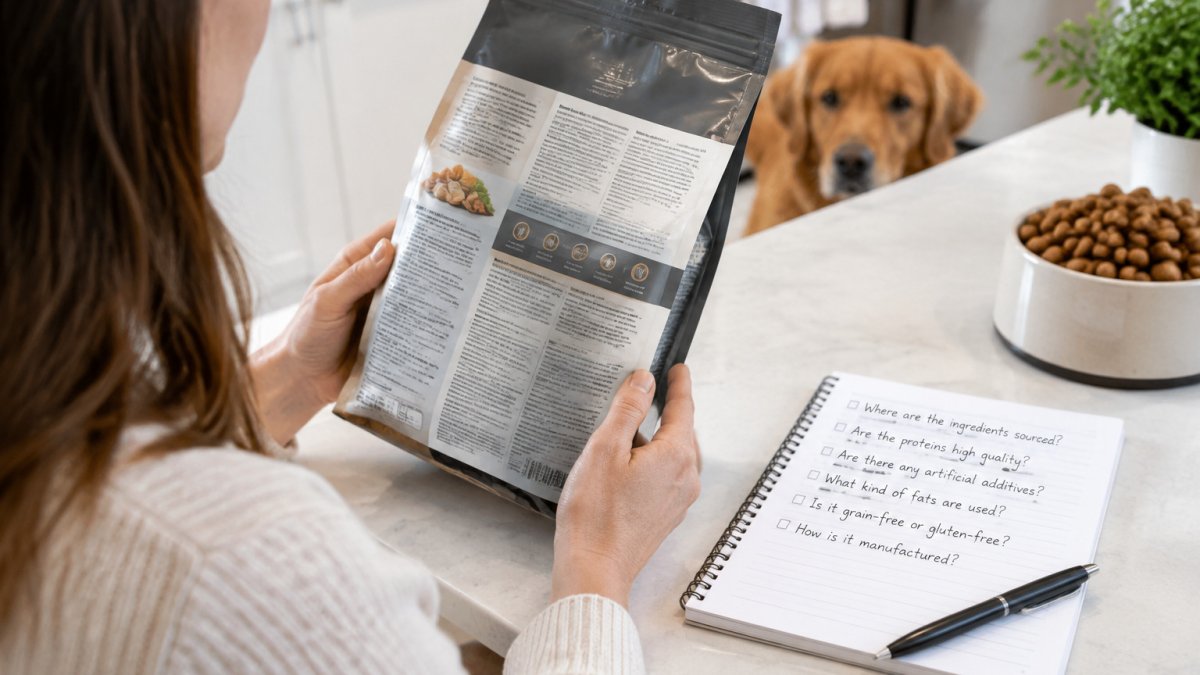
Ask questions like these, and note what a useful answer looks like:
- Which country or region does each main protein come from? A useful answer names a country and, where relevant, a state or region. A country-of-origin statement on a pack is not the same as a supplier claim, and neither is the same as a traceability record. Ask which of the three the brand is giving you.
- Who supplies the main protein, and is the supplier named? Some brands will name the supplier; many will not, citing commercial confidentiality. If the supplier is not named, ask whether the brand will confirm the supplier's country and whether that supplier is audited.
- Are ingredients traced by batch or lot, and can you tell me which batch my bag came from? This is the chain-of-custody question. A brand that can match a lot code on your pack to a supplier and a processing facility has real traceability. A brand that can only say "our chicken comes from suppliers we trust" does not.
- How are suppliers assessed, and how often? Look for a described process: a supplier questionnaire, an on-site audit, a certificate such as a feed-safety or quality-management certification, and a review frequency. "We have long-standing relationships" is not an assessment process.
- Are ingredient substitutions allowed, and how are they disclosed? Substitution policy matters because a named protein on the label can change between batches. Ask whether the brand publishes a substitution policy and whether it notifies customers.
- Is the product tested by an independent laboratory, and can I see the results? Ask which laboratory, what is tested (for example, nutrient analysis, contaminants, or species identification), and whether results are per batch or per formulation.
A company-evaluation framework by Dr Justin Shmalberg recommends asking how suppliers are evaluated, whether major ingredient standards are clear, and whether substitutions are allowed.
For background on feed rules in the US, the Association of American Feed Control Officials notes that a label referring to its model language does not mean the organisation has tested or approved the product.
Watch out: a brand that answers every question with a link to a marketing page, rather than a named record, is telling you that the evidence does not exist in a form you can check.
Step 3: Judge Whether the Answers Are Credible
Getting an answer does not mean the answer is good. Judge the response, not just whether one arrived, and judge the type of evidence offered.
What each type of evidence can and cannot establish:
- Supplier audits show that a supplier was assessed against a defined standard at a point in time. They can establish that a process exists; they cannot establish that every batch met specification, and they usually do not cover the farm level unless the audit scope says so.
- Certificates (for example, feed-safety or quality-management certification) show that a facility's management system has been certified by a body. They can establish that a system is in place; they cannot establish the origin of a specific ingredient or the result of a specific batch.
- Laboratory testing shows what was measured in the sample tested. It can establish nutrient content or the absence of a named contaminant in that sample; it cannot establish where the ingredient came from, and a single result does not describe batch-to-batch variation.
- Third-party certifications (sourcing, welfare, or sustainability schemes) can establish that a defined standard was met for the scope certified. They cannot establish that every ingredient in the product is covered by the certification, so ask what percentage or which ingredients are in scope.
- Lot-level traceability records are the only evidence type that connects a finished bag to a supplier and a processing facility. They can establish chain of custody; they cannot establish that the supplier met a quality standard unless the audit records are also produced.
Strong answers usually have:
- Specific names of countries, regions or suppliers, or a clear statement of why a name is withheld.
- Documentation that can be requested, such as certificates, audit summaries or test reports, with the scope of each document stated.
- Clear limits, where the brand admits what it cannot verify, for example, that it can trace to a supplier but not to a farm.
- Consistency between the answer and the label, and between different answers given at different times.
Weak answers often include:
Korure Pets NZ King Salmon Tails Dog Treats 50g →
- General reassurance with no detail
- Claims that cannot be checked or sourced
- Refusals to name suppliers or share documents, with no explanation of the limit
- Answers that change depending on who you ask
The gap between marketing and evidence is the key point. Ask for the document behind any claim, then ask what that document actually covers.
Watch out: a claim like "ethically sourced" with no named standard and no supporting document is a marketing statement, not evidence. Record it as unverified.
Step 4: Use a Pet Food Quality Checklist Before You Buy
A checklist keeps your decision consistent across products. Use the same questions each time you compare options.
- The main protein is named specifically on the label.
- Animal meals or by-products are explained or supported by supplier information.
- The brand can name where its main ingredients come from.
- Ingredient substitutions are disclosed to customers.
- Independent testing results are available on request.
- A nutritional adequacy statement is present.
| Check | What to look for | Why it matters |
|---|---|---|
| Named protein | Specific animal and cut or species | Shows clearer origin |
| Supplier info | Named supplier or region | Enables follow-up |
| Test results | Independent lab report | Verifies quality claims |
| Substitutions | Disclosed policy | Shows consistency |
The checklist cannot prove sourcing on its own. It gives you a structured way to weigh the evidence you can actually get.
Some products on our site are a good starting point for this kind of check. The Korure Pets NZ King Salmon Tails Dog Treats 50g are a single-ingredient New Zealand King Salmon product, which makes the protein source easy to read on the label. For a meal option with a named protein mix, the Black Hawk Air Dried Beef and Mackerel Dog Food 450g lists both sources clearly.


Booking Your Next Order With Confidence at Easy Pets
Checking sourcing takes a few minutes, and it pays off every time you reorder.
Once you have a shortlist, add your chosen food to cart and keep the brand's answers on file for your next order.
Frequently Asked Questions
How can I find out where the ingredients in my pet's food come from?
Start by checking the label and the brand's website for a country of origin statement, then contact the brand directly and ask which countries each main ingredient is sourced from and whether it is processed locally. Ask for the name of the manufacturing facility and whether it audits its suppliers. A brand that can answer these questions in specific terms is generally more transparent than one that gives only general statements about quality. Keep a copy of the reply so you can compare it with future product updates.
What should I look for on a pet food ingredient label?
Look at the first five to seven ingredients, which make up most of the food by weight, and check whether the main protein is named specifically, such as chicken or lamb, rather than a general term like meat. Check the guaranteed analysis for crude protein, crude fat, fibre and moisture, and look for a nutritional adequacy statement that says the food is complete and balanced for a stated life stage. A label shows what is in the product, but it rarely shows where each ingredient was grown, raised or processed.
Are pet food ingredient lists enough to verify ingredient quality?
No. An ingredient list confirms what is in the bag, but it does not show where ingredients came from, how suppliers were assessed or whether substitutions are permitted between batches. Use the list as a starting point, then ask the brand for supplier information and check whether any independent testing is published. Labels cannot replace direct evidence from the manufacturer.
How can I tell whether a pet food sourcing claim is trustworthy?
Look for specifics that can be checked: named suppliers or regions, batch testing results, certificates from recognised third-party bodies and a clear description of how ingredients are traced. Be cautious of vague phrases such as natural or premium with no supporting detail. A claim is more credible when the brand is willing to provide documents on request and explains what the document does and does not cover.
