

Last Updated: November 3, 2026
Quick Summary
To learn how to choose a dog harness for a deep chested breed, measure the girth at the deepest part of the ribcage and the neck at the collar line, then pick a Y-shaped, multi-point adjustable harness with a chest strap that clears the sternum. Fit it using the two-finger rule and a test walk.
- Weight-based sizing fails deep-chested dogs because it ignores the wide gap between neck and girth.
- Add roughly two centimetres to the girth for short coats and three to four for thick coats.
- Adjust straps in order: neck, chest, girth, then back length, changing one at a time.
- An escape-proof fit needs a high, snug neck opening and a girth strap that stays behind the front legs.
- Gaping at the chest is fixed by lowering the chest strap toward the sternum.
Table of Contents
- Why Standard Sizing Fails a Deep-Chested Dog
- How to Measure a Dog for a Harness in Two Steps
- The Best Harness for Deep-Chested Dogs: What to Look For
- Your Dog Harness Fitting Guide: Adjusting Straps for a Snug Fit
- Building an Escape-Proof Dog Harness Fit
- Fixing Gaping, Slipping, Twisting and Riding Up
- When Fit Changes: Puppies, Coat Growth and Activity
- Add a Harness to Your Cart at Easy Pets
- Frequently Asked Questions
Why Standard Sizing Fails a Deep-Chested Dog
Walk into any pet shop and you'll see harnesses sorted by weight, which is exactly why so many owners ask how to choose a dog harness for a deep chested breed. Small, medium, large.
Weight tells you how heavy a dog is. It tells you nothing about how that weight is arranged. A Greyhound and a Labrador can weigh close to the same. Their bodies are built nothing alike.
Here's the problem in plain terms. A harness sized to fit the chest will gape at the neck. One sized to the neck will cut into the chest.
Body Shape Beats Weight Every Time
Sizing charts assume a dog is roughly barrel-shaped. Deep-chested breeds are closer to a teardrop.
That mismatch causes real problems:
- Straps that look right on the packet but slide loose on the walk
- Neck openings that hang low and let a dog back out
- Chest panels that press on the sternum instead of sitting around it
A 2025 review of collars, harnesses and head collars by C Cavalli and co-authors found that back-clip harnesses suit some dogs well, particularly designs with a chest strap or Y-shape. The same review makes clear that fit, not just style, decides whether a harness works.
Breeds That Fit the Deep-Chested Profile
Some breeds carry this shape as a defining trait. Others are simply deeper than average.
The classic deep-chested group includes:
- Greyhounds and Whippets
- Dobermans
- German Shepherds
- Dachshunds, in miniature
- French Bulldogs, though their challenge is a wide chest and narrow neck together
A German Shepherd's deep chest sits with a sloping back. A Greyhound's is narrow and very deep. Both need a harness that clears the sternum, but the strap lengths differ.
How to Measure a Dog for a Harness in Two Steps
Learning how to measure a dog for a harness takes two measurements and about two minutes. Get these right and most of the fitting work is already done. For a deep-chested dog, the exact points you measure matter more than the numbers themselves, because the gap between neck and girth is what standard sizing ignores.
You need a soft tape measure, the cloth kind used for sewing. A piece of string and a ruler works too. Have a helper hold the dog if it will not stand still, and keep a notebook or phone handy to record both figures.
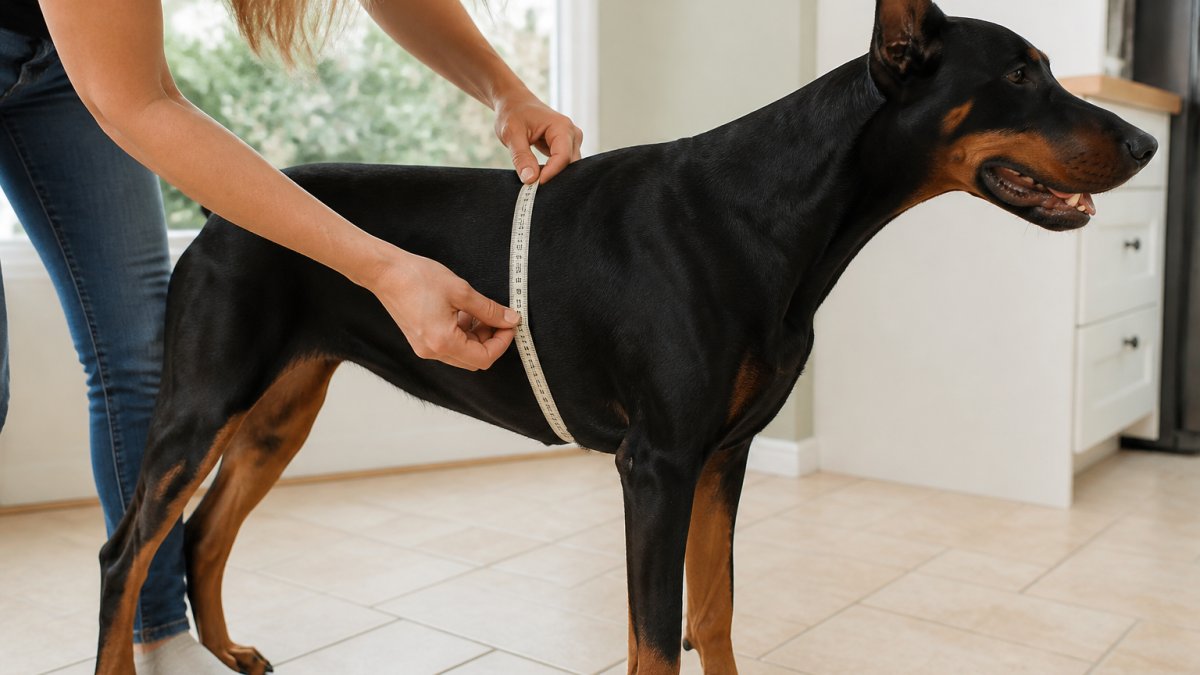
Taking the Girth and Neck Measurements
Girth measurement is the big one. Wrap the tape around the widest part of the ribcage, just behind the front legs.
Neck measurement comes next. Measure around the base of the neck where a collar would sit, not up near the ears.
Write both numbers down. Then add a small allowance for movement and coat.
Two rules keep this accurate:
- Measure a standing dog, not a sitting one
- Measure twice, and use the larger figure if they differ
For a deep-chested breed, the gap between neck and girth is usually wide. That gap is exactly why standard sizing fails.
Halti Walking Harness Red Large →
The Best Harness for Deep-Chested Dogs: What to Look For
The best harness for deep-chested dogs is a Y-shaped, multi-point adjustable design with a chest strap that clears the sternum. Style matters less than geometry.
Most harnesses on the shelf are built for the average dog. A deep-chested dog needs specific features, and these are the ones that count.
Y-Shape, Sternum Coverage and Underbody Clearance
A Y-shaped harness splits around the front legs and leaves the shoulders free. The straps form a Y across the chest rather than a straight bar.
Sternum coverage means the chest strap sits across the breastbone, not on the throat. On a deep-chested dog this strap often needs to sit lower than the default setting.
Underbody clearance is the space between the girth strap and the ground-side of the chest. Too little and the strap rubs the elbow.
Look for these three together. A harness with a Y-front but a fixed chest strap will still sit wrong on a deep chest.
Padding, Pressure Distribution and Shoulder Movement
Padding spreads load. On a deep-chested dog, a narrow strap concentrates pressure on a small area of the chest.
Mobility Dog Resources notes in its harness research on restrictive versus non-restrictive designs that chest design can alter a dog's natural gait. A harness is not automatically non-restrictive just because it is a harness.
Check for:
- Padded chest and girth panels
- Wide straps rather than thin webbing
- A front range that lets the shoulder rotate fully
Watch the dog walk. If the stride shortens at the shoulder, the harness is restricting movement.
Your Dog Harness Fitting Guide: Adjusting Straps for a Snug Fit
This dog harness fitting guide comes down to adjusting four points in the right order, then testing the result in motion. Get the sequence wrong and you'll chase the fit around the body. Most guides stop at the two-finger rule; the step that actually catches problems is watching the harness while the dog walks, trots and turns.
Start at the neck opening. Set it so it sits high on the chest, above the sternum. Then move to the chest strap and set it level. Next, adjust the girth strap so it sits behind the front legs, not across them. Finally, check the back length so the harness doesn't ride toward the tail.
Work in small steps. Adjust one strap, then walk the dog, then adjust again. Change only one setting at a time so you know which adjustment fixed or caused the problem.
The Two-Finger Rule and the Fit Check Walk
The two-finger rule is the simplest test in harness fitting. You should be able to slide two fingers under every strap, and no more.
Too loose and the dog can slip out. Too tight and you'll see rubbing within a day.
Then do a fit check walk, and make it a real test rather than a slow amble. Walk the dog on a loose lead, ask for a trot, and turn in both directions. Watch for these signs:
- Straps that twist as the dog moves
- The harness riding up toward the throat
- Gaps opening at the chest when the dog pulls
- Any change in gait or a reluctance to walk
- The chest strap creeping up toward the throat at speed
A harness that passes the two-finger rule but fails the walk still needs adjusting. Repeat the sequence: neck, chest, girth, back length, then walk again.
Watch out: a harness that looks perfect standing still can shift once the dog lowers its head to sniff, so include a sniff-and-stop in your test walk.
Building an Escape-Proof Dog Harness Fit
An escape-proof dog harness is one a dog cannot back out of, and that comes down to two settings. The neck opening must sit high, and the girth strap must be snug.
Halti Walking Harness Red Large →
Close that door first. A high, snug neck opening removes the exit route.
Then check the girth. A deep-chested dog can slip a loose girth strap forward over the ribs in seconds.
Three checks for escape-prone dogs:
- Test the neck opening by gently pulling the harness back over the head
- Watch for gaping at the chest when the dog pulls backward
- Confirm the girth strap stays behind the front legs during a full walk
If a dog can back out on the test, tighten the neck opening one notch and retest.
Fixing Gaping, Slipping, Twisting and Riding Up
Most harness problems trace back to one strap, and each fault has a clear fix. Diagnose before you tighten everything.
| Problem | Likely Cause | Fix |
|---|---|---|
| Gaping at the chest | Chest strap set too high | Lower the chest strap toward the sternum |
| Slipping out | Neck opening too loose | Tighten the neck opening one notch |
| Twisting straps | Harness too loose overall | Adjust girth and chest to the two-finger rule |
| Riding up the neck | Girth strap too far forward | Move the girth strap back behind the front legs |
| Rubbing at the elbow | Underbody clearance too tight | Loosen the girth strap slightly |
Work through one fault at a time. Change a strap, walk the dog, and check again.
When Fit Changes: Puppies, Coat Growth and Activity
A harness that fits in winter may not fit in summer. Fit is not a one-time job, especially for a deep-chested dog.
Puppies change fastest. A deep-chested breed puppy can add chest depth quickly, so check the fit every few weeks during growth.
Coat changes matter too. A thick winter coat adds bulk under the girth strap. When the coat blows, the same harness can sit loose.
Activity changes the picture as well. A harness set for a calm walk may shift during running or hill work. Recheck after any change in routine.
Add a Harness to Your Cart at Easy Pets
Knowing how to choose a dog harness for a deep chested breed is a measuring job, not a guessing game.
If you're ready to put that into practice, the Halti Walking Harness Red Large is a walking harness in a large size, suited to everyday walks on bigger dogs. Check your measurements against the size before you buy.

Easy Pets stocks more than 8,000 products sourced from trusted Australian manufacturers and distributors, with fast dispatch Australia-wide. Our family team handles each order personally.
Get started with Easy Pets and find a harness that fits your dog's shape, not just its weight.
Frequently Asked Questions
What type of harness is best for a deep-chested dog?
A Y-shaped harness with a chest strap that sits across the sternum and leaves the front legs clear is the usual starting point. Designs with a chest strap or Y-shape are commonly chosen for dogs where pulling is not the main concern. Look for enough adjustment in the girth strap to match a deep ribcage, plus padding where the straps cross the chest.
How do you measure a deep-chested dog for a harness?
Use a soft tape measure for two readings. First, the girth: wrap it around the widest part of the ribcage, just behind the front legs, and record the number. Second, the neck: measure around the base of the neck where the harness collar will sit. Match both numbers to the size chart rather than weight alone, and if your dog sits between two sizes, size up and tighten the adjustable straps.
How can I stop my dog from backing out of a harness?
Check three points before every walk. The girth strap should sit snug enough that you can fit two fingers under it, no more. The neck opening should be tight enough that it cannot slide over the head when your dog reverses. And the chest strap should sit high on the sternum, not low across the belly. A harness that twists or gaps at the chest is the usual reason a dog slips out, so adjust before you head out.
Can a harness restrict a dog's shoulder movement?
Yes. Harness design can affect a dog's natural movement, and wearing one is not automatically non-restrictive. Chest design can alter a dog's natural gait. Watch your dog walk and trot: if the front legs swing short or the shoulder looks pinched, the chest strap is sitting too low or too tight. A Y-shaped front that clears the shoulder joint usually gives the fullest range of motion.
