

Last Updated: November 2, 2026
Quick Summary
Buying pet food in bulk in Australia saves money only when you use the food before it goes stale and delivery costs or minimum spends do not cancel out the discount. Work out cost per meal, not shelf price, and size each order to last roughly six to eight weeks.
- Compare the total delivered price per kilogram across pack sizes, not the shelf price alone.
- Keep no more than about six to eight weeks of dry food on hand to limit spoilage.
- Weigh your pet's actual daily intake rather than relying on scoop size.
- Store dry food in its original bag inside a sealed, airtight container, away from heat and humidity.
- Once opened, wet food should be refrigerated and used within the timeframe on the label.
Table of Contents
- Comparing Cost Per Meal Across Pack Sizes
- How Much Pet Food Should You Order at Once?
- Bulk Formats and Life-Stage Options to Consider
- How to Store Dry Pet Food Safely
- Pet Food Shelf Life After Opening
- Where to Buy Bulk Pet Food and Check Delivery Costs
- Next Step: Working Out Your Right Order Size
- Frequently Asked Questions
Buying pet food in bulk in Australia can cut your cost per kilogram, but the saving is smaller and more conditional than most shoppers expect. A bigger bag only wins when you actually use it before the food goes stale, and when delivery and minimum spends do not eat the discount. Easy Pets, an Australian family-owned online retailer, stocks large formats from Australian manufacturers and distributors.
The pattern holds across the sector. IBISWorld reports that online pet food and supply sales has 406 businesses and grew at a compound annual growth rate of 3.1% between 2021 and 2026 (IBISWorld industry profile for online pet food and supply sales). More choice means more bulk formats to compare, and that makes the maths worth doing yourself.
Bulk offers come in several forms. Some wholesale suppliers set a minimum spend, plus shipping, before a discount applies. BDPS Wholesale, for example, lists a $375 minimum spend plus shipping and a 5% discount on carts of $1,000 or more (BDPS Wholesale bulk purchasing terms). Those thresholds are high for a single household, so check them against how much your pets really eat.
Watch out: a large bag bought at a lower unit price can still cost more overall if it sits unused past its best-before date.
The advice is to work from the cost per meal, not the shelf price. Compare the total delivered price per kilogram across pack sizes, and include the cost of any packaging you may need to buy for storage.
Comparing Cost Per Meal Across Pack Sizes
The fairest comparison is price per kilogram, then cost per meal once you know how much your pet eats. A 20kg bag of adult cat food such as Advance Cat Adult Ocean Fish 20Kg is listed at $390.95, and a 20kg bulk bag of Supervite Everyday Working Dog is listed at $80.95 (Supervite Everyday Working Dog 20Kg). Those prices are for different foods, so only compare like with like.


| Pack size | Best for | What to check |
|---|---|---|
| Small (1-3kg) | Trial feeds, small pets | Highest cost per kg |
| Medium (5-8kg) | Single pet, monthly restock | Shelf life after opening |
| Large (15-20kg) | Multi-pet or large-dog homes | Storage space and delivery cost |
Work out how many days a bag lasts, then divide the delivered price by the number of meals. That single figure shows whether the bigger pack really saves you money.
How Much Pet Food Should You Order at Once?
Order enough to last until your next planned purchase, plus a small buffer. A common rule is to keep no more than about six to eight weeks of food on hand, which limits the risk of the food going off. Check the feeding guide on the pack, weigh a week's portions, and multiply up.
Supercoat Adult Healthy Weight Chicken 18Kg →
A simple method works better than guesswork. First, weigh what your pet actually eats in a day rather than relying on the scoop size on the pack, because scoop density varies between formulas. Second, multiply the daily amount by the number of pets and by seven to get a weekly total. Third, divide the net weight of the bag by that weekly total to see how many weeks one pack lasts. Fourth, compare that figure with the best-before date and with your storage space.
For example, if two medium dogs eat a combined 500g of dry food a day, that is 3.5kg a week. A 20kg bag therefore lasts about five and a half weeks, which sits comfortably inside a six-to-eight-week window. A single small dog eating 150g a day uses just over 1kg a week, so a 20kg bag would last around 19 weeks and is likely to go stale before it is finished. In that case a 5-8kg bag bought more often is the better value despite the higher unit price.
Account for your delivery schedule too. If shipping costs or minimum spends apply, a larger order may be the only way to clear them, so the saving has to be weighed against the extra stock you carry. If you order monthly, size the pack to last roughly one month plus a week's buffer rather than buying the largest bag available.
Watch out: feeding guides are starting points, not prescriptions. Activity level, age, neutering status and health conditions change how much a pet needs, so weigh your pet regularly and adjust the daily amount before you commit to a bulk pack.
Bulk Formats and Life-Stage Options to Consider
Bulk buying is not one format. Dry food suits large bags and long storage. Wet food comes in multipacks, and it is better bought in smaller quantities because it spoils quickly once opened. Life stage matters as well. A puppy or kitten needs a different formula from an adult pet, so do not buy a large bag of the wrong life stage.
For a large adult dog, a bag such as Supercoat Adult Healthy Weight Chicken 18Kg at $121.95 suits a household that feeds the same food every day. For multi-dog homes, the My Dog Wet Country Lamb And Liver 400G 24Pk at $127.95 is a 24-pack option for wet feeding.

How to Store Dry Pet Food Safely
Keep dry food in its original bag inside a sealed, airtight container, in a cool, dry, pest-free place away from direct sunlight. Heat and humidity cause fats to oxidise and invite mould, so avoid garages and laundries where temperatures swing.
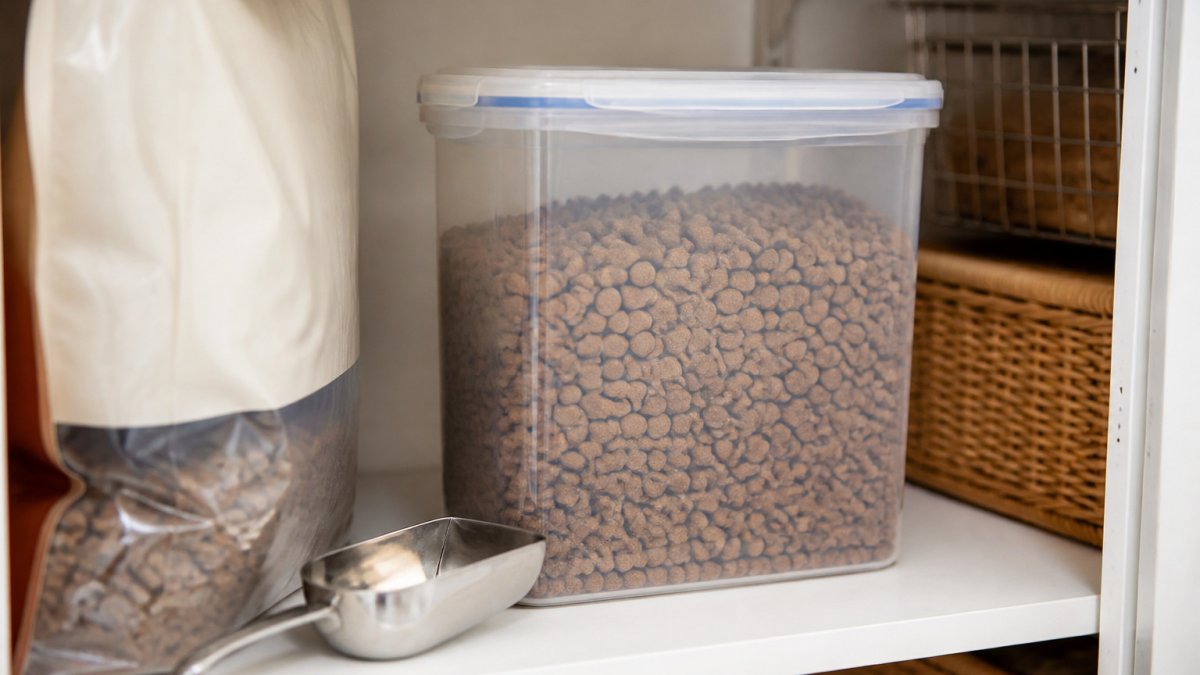
!A tidy pantry shelf with a sealed airtight plastic container of dry dog kibble beside a scoop and a labelled bag, in soft natural light
Choosing Pet Food Storage Containers
Choose a container with a tight-fitting lid, a capacity that fits the bag, and a food-safe material. Clean it fully before refilling, and do not top up old food with new. Keep the original best-before date visible so you can use the oldest stock first.
Pet Food Shelf Life After Opening
Once opened, most dry food should be used within a set period printed on the pack, and the safest rule is to follow that date rather than guess. Seal the bag tightly and store it in a dry place. Wet food should be covered and refrigerated after opening and used within the timeframe on the label. Shelf life varies by product, so the manufacturer's guidance is the authority here.
The practical problem with bulk dry food is that the clock starts when the bag is opened, not when it is bought. Most manufacturers print a best-before date for the unopened pack and separate guidance for use after opening, often expressed as a number of weeks. A large bag that takes three months to finish may be past its quality peak long before the printed date, even though it is technically safe. Fats oxidise once air is introduced, which is why stale kibble smells rancid and loses palatability.
Supercoat Adult Healthy Weight Chicken 18Kg →
Signs that dry food has deteriorated include a sharp or paint-like smell, faded colour, soft or clumping texture, and a pet that suddenly refuses food it previously ate. If you see mould, insects or condensation inside the container, discard the whole batch rather than scooping around it.
Wet food is less forgiving. Once a pouch or can is opened, refrigerate any unused portion in a covered container and use it within the period stated on the label, typically a couple of days. Do not leave wet food at room temperature for long periods, and do not refreeze thawed raw or wet food unless the manufacturer explicitly says it is safe to do so.
Frozen and raw formats need their own handling. Keep them frozen until use, thaw in the refrigerator rather than on the bench, and use thawed portions within the timeframe on the pack. A freezer thermometer helps confirm your freezer is holding a safe temperature, and labelling containers with the date you opened or thawed them makes rotation much easier.
Watch out: topping up an old bag with new food resets neither the age of the oldest kibble nor the risk of spoilage. Empty and clean the container between refills, and use the oldest stock first.
Where to Buy Bulk Pet Food and Check Delivery Costs
Buy from a seller who lists the product, its pack size and the full delivered price before checkout. Compare the cost with shipping included, and check any free-shipping threshold. Easy Pets lists its products with their pack sizes and prices, and offers free shipping on light items over $120 up to 10kg in selected areas. For guidance on confirming a seller and the authenticity of the food before you order, see how to verify Australian pet food.
Next Step: Working Out Your Right Order Size
Work out how much your pets eat each week, check the pack size and delivered price, and calculate the cost per meal before you order. Then choose the size that lasts your household within its shelf life. Easy Pets can help you compare the bulk options in our range, and our family team handles orders personally, with fast dispatch across Australia.
Frequently Asked Questions
Is it cheaper to buy pet food in bulk?
Usually, yes, but only once you compare the price per kilogram and the delivered cost. Large bags such as Supercoat Adult Healthy Weight Chicken 18Kg at $121.95 or Advance Cat Adult Ocean Fish 20Kg at $390.95 often lower the cost per kilogram, while shipping and minimum spends can cancel the saving. Divide the total price, including delivery, by the weight to get a fair comparison.
How should you store bulk dry pet food?
Keep dry food in its original bag inside an airtight container, in a cool, dry and dark place away from direct sun, heat and pests. Transfer only what you need for about a month into a clean, labelled container, and never top up old food with a fresh batch. Wipe the container regularly so oils do not build up and attract pests.
How long does dry pet food last after opening?
Shelf life varies by brand and formula, so check the best-before date and any storage advice printed on the pack. Once opened, most owners aim to use dry food within a few weeks to keep it fresh and palatable. Seal it tightly after every use, and discard food that smells stale, rancid or shows mould or clumping.
How much pet food should I buy at once?
Work out how many days your pet's current bag will last, then buy enough to cover the time between deliveries plus a small buffer. Only buy a quantity you can use before the best-before date, and do not stock up so much that food sits open for longer than it stays fresh. Larger packs suit multi-dog or large-dog households that use food quickly.
